The life
Pelham Grenville Wodehouse
Born 15 October 1881 in Guildford; died 14 February 1975 on Long Island. Known as Plum. Pronounced Wood-house. Knighted six weeks before the end.
A childhood of aunts
He arrived early, at an aunt’s house in Guildford, while his mother was home from Hong Kong. Ernest Wodehouse was a magistrate in the colony; Eleanor, née Deane, soon took the baby East and then, with his two elder brothers, sent him back to England for good. From the age of two he was raised by governesses and a rotating cast of aunts and uncles. He barely saw his parents until his father retired. It is not a mystery that aunts — terrifying, managing, occasionally beloved — crowd the fiction.
Dulwich, and the bank
After a dame school in Croydon, Elizabeth College in Guernsey, and Malvern House at Kearsney, he followed his brother Armine to Dulwich College in 1894. He was happy there as he was happy almost nowhere else: cricket, rugby football, Latin verse, and the school paper. Oxford was the plan; the family finances objected. In September 1900 he was found a stool at the Hongkong and Shanghai Bank in Lombard Street. He was a poor clerk and a busy moonlight writer. When The Pothunters appeared in 1902 and Punch was paying, he resigned.
Two countries, a wife, a valet
School stories paid the rent; then New York magazines paid it better. He crossed the Atlantic, sold to the Saturday Evening Post, and on 3 August 1914 met Ethel Wayman, an English widow, at a New York party. They married on 30 September. He adopted her daughter Leonora and never wrote a love scene as devoted as the real marriage. Poor eyesight kept him out of the army. In 1915 Something Fresh opened Blandings Castle; “Extricating Young Gussie” introduced Bertie and a manservant named Jeeves. By 1916 the valet was running the show.
Lyrics, Hollywood, Le Touquet
With Guy Bolton and Jerome Kern he helped invent the modern American musical at the Princess Theatre. He put words to “Bill” in Show Boat and later to Cole Porter on Anything Goes. An MGM contract in 1930 paid him a fortune to sit in an office; he said so to a reporter, and Hollywood sulked. The episode became novels. Double taxation and Britain’s dog-quarantine laws then drove the household, dogs included, to Low Wood at Le Touquet in 1934 — a quiet villa, a typewriter, and the Channel.
Internment and the broadcasts
In May 1940 the German army arrived. Wodehouse, 58, was interned as an enemy alien: Loos, Liège, Huy, and the camp at Tost in Upper Silesia. He wrote Money in the Bank there. Released in June 1941 because of his age, he agreed to record five humorous talks on internment for American radio. The scripts mock camp life and do not praise the Reich; they were, even so, made in Berlin, for an enemy transmitter, while Britain stood alone. The row never quite died. MI5’s Cussen Report found no treachery; it was not released in his lifetime. He was not officially cleared, and he never lived in England again.
Remsenburg, and the last page
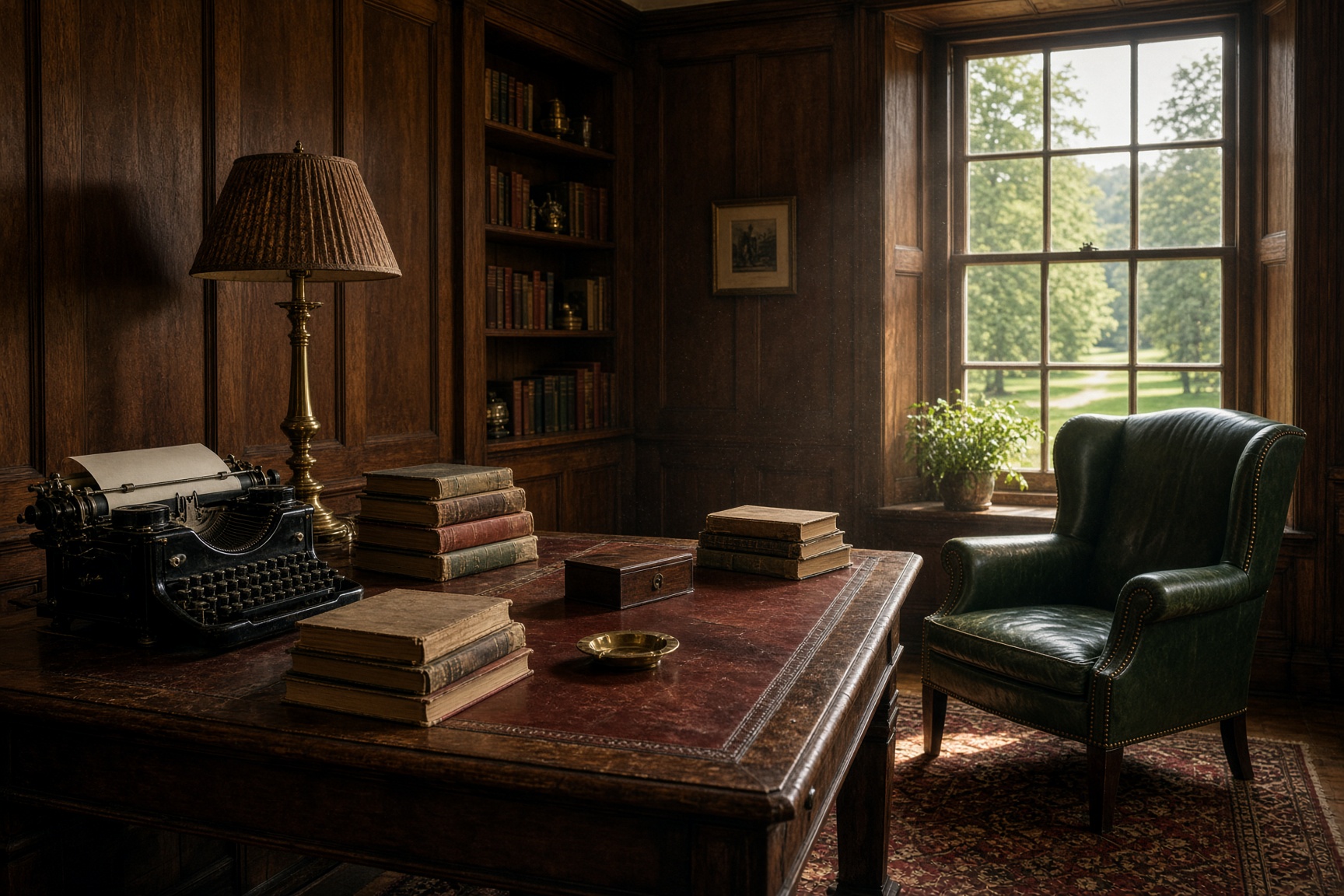
From 1947 the Wodehouses were American residents; from 1952 they were of Remsenburg, a village in Southampton, Long Island. He took US citizenship in 1955, walked the Pekes, listened to soap operas, and wrote every morning as if Market Snodsbury had never heard of a world war. The late Jeeves and Blandings novels are among his best. On 1 January 1975 he was appointed KBE. On 14 February he got out of bed, walked across the room, and died of a heart attack, aged 93, with Sunset at Blandings still open on the desk. A memorial stone was dedicated in Poets’ Corner at Westminster Abbey on 20 September 2019.